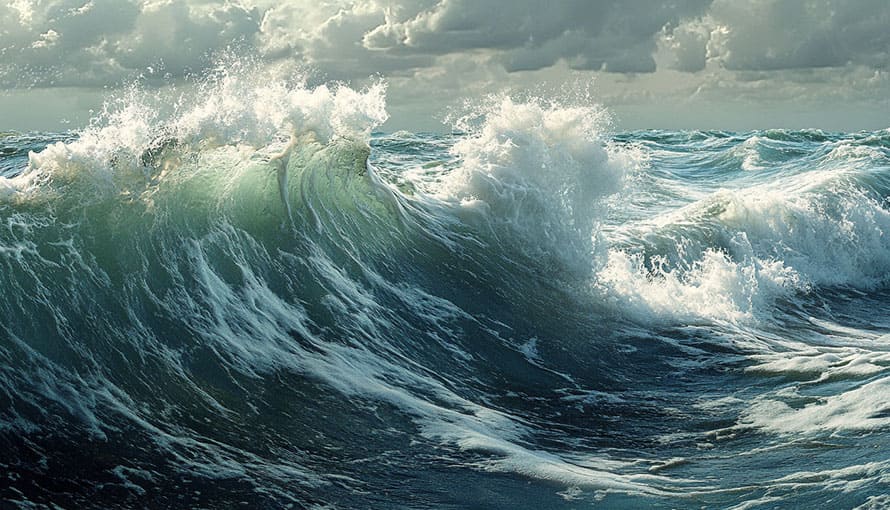
Ocean waves are a fascinating natural sight you can watch whenever you visit the beach. But how do they actually form?
How Wind Generates Waves
Waves begin their journey thanks to the wind. When the wind blows across the surface of the sea, its force pushes against the water and creates small ripples. The longer and stronger the wind blows, the bigger and more powerful the waves become. These waves can travel hundreds of miles (hundreds of kilometers) before reaching the shore.
What Determines Wave Size? (Fetch, Wind Speed, and Duration)
Not all windy days make big waves. Wave size mainly depends on three factors: wind speed (how fast the wind blows), duration (how long it blows), and fetch (the distance over which the wind blows across open water). Strong winds blowing for a long time over a long fetch create larger, more powerful swells that can travel far across the ocean.
Visualizing Wave Motion: The Carpet Analogy
Picture a wave as a bump on a carpet when someone pushes it from one side. As the bump moves across the carpet, the carpet itself stays mostly in place—it’s the energy that moves forward. The same happens with ocean waves: the water rises and falls, but the wave’s energy moves forward across the sea.
Try It Yourself: Simple Wave Demonstration
Try this wave demonstration at home! If you have a long string, ribbon, or rope, have a friend hold one end tightly. Take the other end, pull it tight, and move your hand quickly up and down. You’ll see a wave travel down the string, just like an ocean wave.
Beyond Wind: Tsunamis Explained
Waves don’t form only because of wind. Sometimes, underwater earthquakes or volcanic eruptions release huge amounts of energy into the water, creating giant waves called tsunamis. Tsunamis are much bigger and stronger than wind-driven waves and can be very dangerous.
Why Waves Break Near the Shore
When waves get close to the shore, they start to grow because the seafloor becomes shallower. The wave’s energy is concentrated into a smaller area, so the wave becomes taller. Finally, the wave breaks on the beach and creates the white foam we see.
Key Takeaway
That’s how waves are born and travel across the sea—bringing joy to swimmers and beach lovers, and making us marvel at their power from the shore.
Read the story about ocean wave!