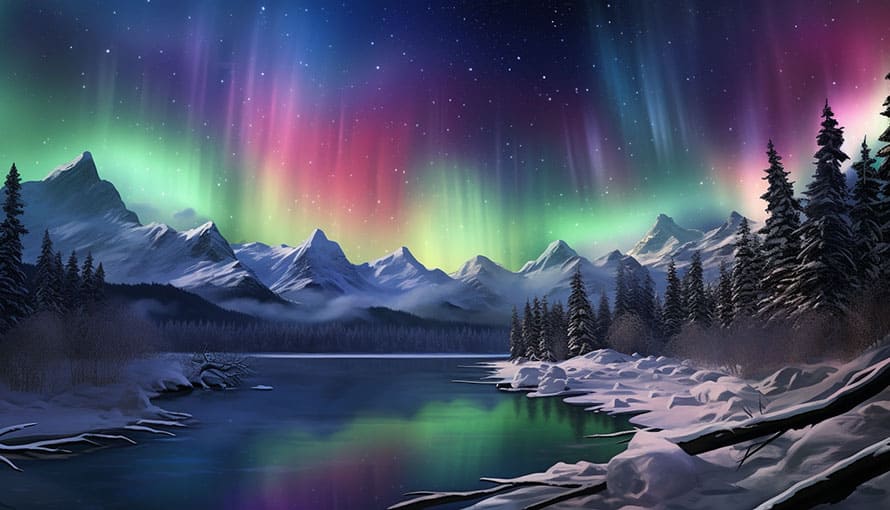
Imagine the night sky turning into a giant, glowing curtain that ripples and waves. That’s the Northern Lights, also called the aurora borealis. These lights usually appear in places close to the North Pole and can look green, pink, purple, or even red. Sometimes they stretch like long ribbons, sometimes they swirl like dancing smoke, and sometimes they shine in tall, glowing “curtains.” When they show up, the sky suddenly feels alive, like it’s doing its own happy dance.
What Makes the Lights Glow? The Simple Science
The Northern Lights happen when tiny charged particles from the Sun ride the “solar wind” toward Earth. Our planet’s magnetic field guides those particles toward the polar regions, where they meet gases high in the atmosphere. When the particles bump into those gases, the sky lights up!
Oxygen high in the sky can glow green (most common) and sometimes red. Nitrogen can glow blue and purple. This light show usually happens very high above us—roughly 60 to 250 miles up—much higher than airplanes fly and far above the weather where clouds form.
Colors and Shapes: Decoding the Aurora’s Look
Where and When to See the Northern Lights in America
In the United States, Alaska is the best place to see the Northern Lights. Towns like Fairbanks and places near Denali National Park are famous for bright shows in fall, winter, and early spring when nights are long and dark. Sometimes, during strong solar storms, people in northern states like Minnesota, Wisconsin, Michigan, North Dakota, Montana, and Maine can see the aurora too. To boost your chances:
Space Weather: The Sun-Earth Connection
The Sun doesn’t just shine; it also sends out streams of particles and bursts of energy called solar wind and solar storms. When those streams are strong and aimed at Earth, the Northern Lights can be brighter and stretch farther south. Grown-ups can check an aurora forecast from trusted sources like NOAA’s Space Weather Prediction Center to see if a show might happen.
Are There Southern Lights Too?
Yes! The Northern Lights have a twin in the Southern Hemisphere called the aurora australis, or Southern Lights. They shine around Antarctica and parts of the far south. Both auroras are part of the same space-weather story, just at opposite ends of the planet.
How to Watch Like a Pro (Kid-Friendly Tips)
Stories, Myths, and Wonder
People have told stories about the Northern Lights for thousands of years. Some northern communities imagined spirits dancing in the sky; others thought the lights were messages or good luck. Today, scientists know the aurora is a natural space-and-atmosphere event, but it still feels magical. It’s okay to be amazed—science and wonder make a great team!
Kid-Friendly FAQs
Q: What causes the Northern Lights?
A: Charged particles from the Sun hit gases high in Earth’s atmosphere, making the sky glow.
Q: Why are the lights usually green?
A: Green is the most common color from oxygen in the upper atmosphere. Pink, purple, and red can appear during stronger shows.
Q: What time is best to look?
A: Late evening to early morning on dark, clear nights. In Alaska, fall through early spring is prime time.
Q: Can I see them from my backyard?
A: If you live far north with dark skies, maybe! If you’re farther south, you might need a very strong solar storm—or a family trip to Alaska.
Q: Are the Northern Lights dangerous?
A: No, they happen far above where people live and fly. They are safe to watch from the ground.
Try This: Make an “Aurora Art” at Home
Create your own aurora-inspired art to learn about color blending.
Materials: Black paper, soft pastels or chalk, a tissue, and a white crayon.
Steps: Draw soft bands of green, purple, and pink. Use a tissue to smudge the colors upward in sweeping motions to make “curtains.” Add tiny white dots for stars. Hang it up and tell the story of your sky!
Key Takeaways for Kids
Read the story about the northern lights!