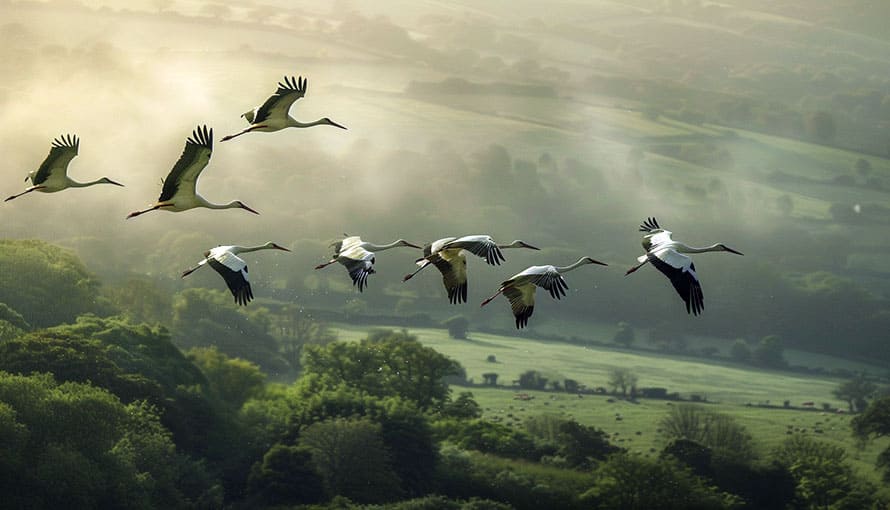
Every year in spring, we can watch beautiful storks return to their nests to raise their chicks. But you might wonder: how do these big birds manage to come back to the same place year after year, even though they fly thousands of miles?
A Magical Compass and a Map in Their Heads
Storks, like many other birds, have an amazing ability to find their way over long distances. They have an inner compass and a cognitive “map” in their heads. Scientists have discovered that storks use several methods to navigate. One method involves using the sun. During the day, storks rely on the sun’s position in the sky to help them figure out which direction to fly.
Stars as Night Guides
At night, storks can use the stars for navigation. They orient using star patterns and constellations to stay on course. It’s as if every stork has a little map of the night sky in its head.
Smells and the Earth’s Magnetic Field
Besides the sun and stars, storks use other cues to find their way. One fascinating skill is sensing the Earth’s magnetic field. This serves as an additional compass, helping them when clouds obscure the sun or stars. Some studies also suggest that certain birds use olfactory cues (smells) in the air, which may help guide them back to familiar regions and nesting areas.
Remembering Their Nesting Places
As if that weren’t enough, storks also have excellent memories for places where they were born or previously built nests. When they return from their wintering grounds, they often fly straight to the same site as the year before. Many young storks show natal philopatry, returning to the region where they hatched once they are old enough to breed.
So as you can see, storks are truly amazing birds with fantastic navigation skills. Next time you see a stork circling above its old nest in spring, remember the long and difficult journey it had to make—and how many different “tools” it used to find its way home.
Would you like to read a story about storks?