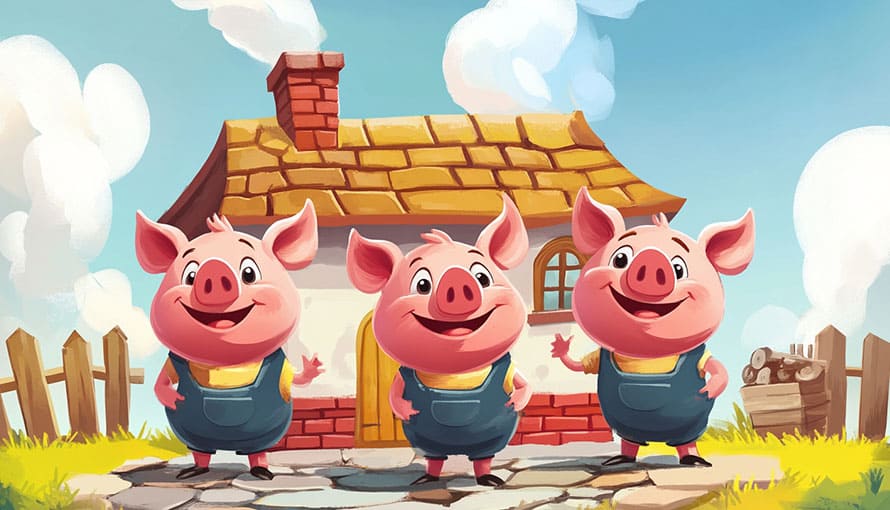
Once upon a time, there were three little pigs—brothers who decided it was time to build their very own homes. Each pig wanted a cozy, safe spot to live, but they all had different ideas about building.
The youngest pig was playful and loved exploring the world—but most of all, he liked to relax and have fun. So when he found a field full of dry straw, he got a bright idea. He bundled the straw into thick bunches and quickly slapped together some walls and a roof. His house looked cute and cozy, but it wasn’t very strong.
“Now I have my very own place!” he thought, flopping down to rest. “No worries for me—I can play all day!”
And so, he stretched out inside, humming to himself, sure that nothing could bother him.
The second little pig was a bit more hardworking than his youngest brother. He wanted to have fun, but also wanted a sturdy place to stay. He decided to use sticks and branches—stronger than straw, but still easy to build with. He carefully stacked and tied them together to make his house. It took a little more time, but not too much.
When it was done, he looked at his work and said,
“Good enough! I could have made it even stronger, but why bother? This should do the trick.”
He settled in, satisfied that his house would keep him safe.
But the oldest pig was the wisest and most careful of them all. He was determined to make a house that would protect him from even the wildest storms and all the dangers of the woods. He patiently laid brick after brick, mixing mortar and stacking each row just right. It took a long time—much longer than his brothers’ houses—but when he was done, his home was strong, with thick walls and a sturdy roof.
Wiping sweat from his brow, the oldest pig smiled:
“I’m tired, but it was worth it. Nothing will surprise me in this house—not wind, not rain, and not any trouble from the forest!”
One day, a mean, hungry wolf was prowling through the woods. He sniffed around until he came upon the straw house, where the youngest pig lay snoozing. The wolf banged on the door and growled:
“Little pig, little pig, let me come in! If you don’t, I’ll huff and I’ll puff and I’ll blow your house down!”
The little pig squealed and hid in the corner, refusing to open the door. The wolf took a deep breath and blew—whoooosh!—and the straw house flew apart as if it were made of tissue paper. The little pig barely escaped and ran as fast as he could to the house made of sticks.
The wolf, licking his lips, chased right after him.
The youngest pig slipped inside the stick house. His brother locked the door tight, hoping the wolf wouldn’t be able to get in.
But soon enough, the wolf caught up and shouted:
“Let me in! If you don’t, I’ll huff and I’ll puff and I’ll blow your house down!”
The pigs shook in fear, begging the wolf to go away. But the wolf took another mighty breath and blew the stick house to pieces! Both pigs ran for their lives, racing straight to the oldest brother’s brick house, their last hope.
The oldest pig, already on the lookout, let his brothers inside and quickly locked the door and bolted the windows. The three little pigs huddled together, waiting for the wolf to arrive.
The wolf snarled at the sight of the brick house:
“This may be a stronger house, but it won’t stop me! If you don’t let me in, I’ll huff and I’ll puff and I’ll blow your house down!”
He sucked in the biggest breath yet and blew…and blew…but the brick house didn’t move an inch. Not even a tremble! The wolf tried and tried, but all he did was get angrier and angrier.
“Fine,” the wolf thought, “if I can’t blow it down, maybe I can sneak in another way.” He noticed the chimney and decided he’d climb right down into the house. But what the wolf didn’t know was that the oldest pig had thought of everything! He had a fire going in the fireplace under the chimney, with a huge pot of boiling water right on top.
When the wolf slid down the chimney—SPLASH!—he landed right in the steaming hot pot! He yelped and leaped up, his tail and paws all singed. With a howl, he shot back up the chimney and raced into the deep, dark forest, never to bother the pigs again.
The youngest and middle pigs sighed with relief and hugged their big brother tight. They realized that all his hard work and patience had saved them all. From that day on, they understood that sometimes it’s worth putting in extra effort—even if it takes longer—because good work lasts and keeps you safe.
And so, the three little pigs lived together in their solid brick house, safe and sound, watching out for each other. The wolf, on the other hand, remembered his burns forever and kept far, far away from the clever little pigs.
Prečítajte si aj vtipnú verziu rozprávky O troch prasiatkach
What Lessons Does “The Three Little Pigs” Teach Children?
Fun Facts About the Story
- Origin and First Recordings
“The Three Little Pigs” is one of the best-known English folktales. The first written version appeared in James Halliwell-Phillipps’s The Nursery Rhymes of England in 1842. Later, Joseph Jacobs included it in his English Fairy Tales collection in 1890, helping the story reach a wider audience. - Plot and Central Message
In the story, each pig builds a house—one from straw, one from sticks, and one from bricks. The wolf sets out to blow down their houses and gobble them up. The first two houses are easily destroyed, but the brick house stands strong. The tale teaches the value of careful planning, forethought, and hard work—which always pay off in the end. - Different Endings
Older versions of the story were quite a bit harsher; sometimes the wolf ate the first two pigs before being outwitted by the third. Modern versions, especially those for younger children, tell the story in a much milder way so it isn’t too scary. - Metaphor and Symbolism
Each house represents a different approach to life. The straw and stick houses stand for quick, easy, but weak solutions. The brick house is a symbol of patience, effort, and proper preparation, showing that strong foundations keep us safe when challenges come. - Disney’s Version
One of the most famous adaptations is Walt Disney’s 1933 animated short, which also introduced the catchy song “Who’s Afraid of the Big Bad Wolf?” This film made the story famous around the world and played a big role in the early success of Disney Studios. - Big Cultural Influence
In English-speaking countries, the phrase “Who’s afraid of the Big Bad Wolf?” became a well-known saying, used to express courage or the willingness to face challenges. The story is often cited as a lesson about careful planning, perseverance, and taking risks seriously. - Modern Versions and Parodies
The story has been reimagined countless ways—in books, comics, plays, TV series (including fairy tale crossovers), and even parodies. Sometimes the story is told from the wolf’s point of view, playfully twisting the original tale. - Timelessness
The story’s themes—dangers from the outside world (the wolf) and the importance of smart protection (the brick house)—are timeless. That’s why “The Three Little Pigs” remains popular today, as everyone can relate to the choice between taking the easy path or working hard for a safe and lasting result.