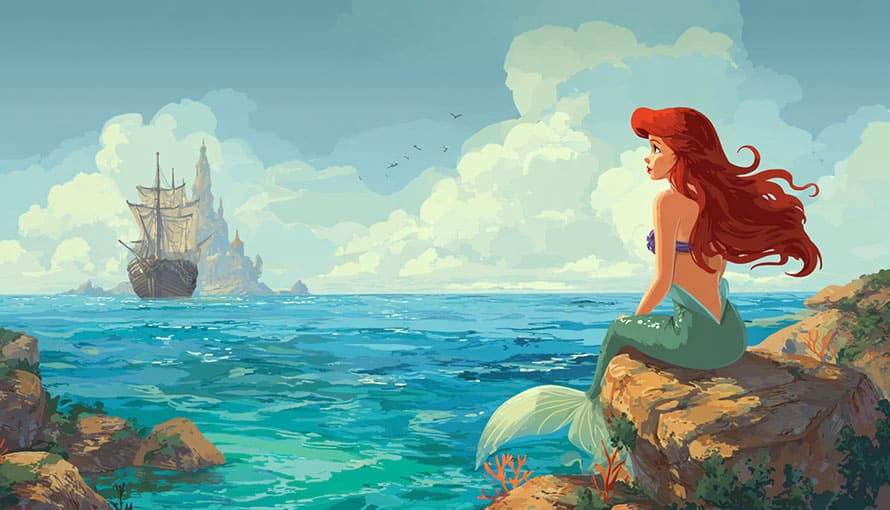
Long ago, deep beneath the surface of the sea, there lay an underwater kingdom. At its heart stood a beautiful palace of pearls, shells, and colorful coral. The Sea King ruled this kingdom, and he had several daughters—mermaids, each graceful with a clear, enchanting voice. The youngest, named Ariel, was the most beautiful, curious, and eager to learn about the world above.
Ariel loved asking questions about life beyond the ocean. She listened intently to stories of flowers, animals, and humans, whose ships were tossed by the waves. Her older sisters had already visited the surface and told her tales of sunlight, twinkling stars, and singing sailors. Ariel longed for the moment when she’d be old enough to see the wonders above for herself.
At last, the day arrived. Ariel surfaced from the water and was amazed by the sky’s dazzling blue and the unfamiliar scent of the air. She saw a great ship nearby, full of singing and laughter. Most of all, she noticed a handsome young prince standing at the rail, noble and kind.
As night fell, a terrible storm broke out. Waves rose high, thunder split the sky, and the ship was smashed against the rocks. Ariel rushed to save the prince, carrying him to shore near a temple. She gently stroked his forehead and wished he’d open his eyes to see who had helped him. But as voices called from the temple, Ariel slipped away, hiding in the sea.
Soon, a girl from the temple found the prince and took him inside. When he woke, he thought she had saved him. He never knew about the little mermaid who watched over him from the waves.
Ariel could not forget the prince or the human world. She longed to walk with him, to talk, and to gain a human soul.
“Humans live much shorter lives than we do,” warned her wise grandmother, “but they have eternal souls. We live for centuries, but after death, we turn into sea foam and vanish forever. This may break your heart.”
But Ariel’s yearning was too great. She dreamed of living among humans and of the prince she loved.
Desperate, she sought out the Sea Witch, who lived in the shadows among seaweed and sharp rocks. The Witch offered a strange potion that would turn Ariel’s tail into human legs—but at a heavy price. It would cost Ariel her beautiful voice, and every step would feel like knives.
“With each step, your feet will hurt as if you’re walking on sharp knives,” the Witch warned. “If the prince does not marry you, you’ll become sea foam. Think carefully!”
Ariel, determined, paid with the thing she valued most—her voice. She could no longer sing or speak.
Ariel swam to shore and drank the magical potion. Pain surged through her, and she fainted. When she awoke, her tail had become human legs.
Soon the prince passed by and noticed the unknown girl. But he didn’t realize she was truly his rescuer from the storm, and since she couldn’t talk, she couldn’t explain.
The prince was taken by her delicate beauty and gentle spirit, and he wanted her close. He brought her to his palace, and they spent much time together. Ariel walked beside him, smiling and doing her best, even as every step was painful—her heart belonged to him.
Time passed, and the prince grew fond of Ariel. But he still remembered the girl from the temple, whom he believed had saved his life. Eventually, the royal court announced that the prince would marry the girl from a distant kingdom—the one he had met at the temple. But she was not his true savior.
Ariel realized that if the prince married someone else, she would become sea foam, just as the Witch had warned. Despite all her pain, she did not regret her choices—she only hoped the prince would find his way back to their love.
The wedding took place on board a ship sailing to new lands. On the eve of the wedding, Ariel watched the prince smile at his bride, her heart full of sorrow. Her sisters, swimming nearby, brought her a knife they had bought from the Sea Witch at great cost.
“If you kill the prince,” they said, “and his blood touches your feet, your tail will return and you can live among us. You won’t die as sea foam.”
Ariel held the knife but, out of love, could not harm the prince. She chose to lose her life rather than destroy her beloved’s happiness.
Ariel climbed to the deck and tossed the dagger into the sea, then leaped into the waves herself. Instantly, her body turned into sea foam. But instead of disappearing forever, her pure and selfless love granted her an immortal human soul.
Lessons from The Little Mermaid
Interesting Facts About the Tale
- Author and Origins
Hans Christian Andersen, the Danish writer, penned The Little Mermaid, first published in 1837. - A Sad Story
Unlike most fairy tales, the original version has a sad and touching ending—Ariel (not named in Andersen’s original) turns to sea foam because her love for the prince remains unfulfilled. - Disney Version
Disney’s 1989 animated film gives a happy ending—Ariel becomes human and marries the prince. Many critics note how the adaptation differs and how it softens or omits some of the deeper themes of the original. - Statue in Copenhagen
A famous bronze statue of The Little Mermaid sits in Copenhagen and is one of Denmark’s most visited tourist sites. It was commissioned by brewer Carl Jacobsen and unveiled in 1913. - Inspiration
Some experts believe Andersen was inspired by his own feelings of unrequited love when writing this tale. - Adaptations
Beyond Disney, The Little Mermaid has inspired ballets, movies, stage plays, and musicals worldwide. - Symbolism
In Andersen’s original, the mermaid gives up her voice for legs—a symbol of sacrificing what is most valuable to pursue one’s deepest desire.
The Little Mermaid tells the story of a young mermaid who falls in love with a human prince. She gives up her beautiful voice and endures great pain by gaining legs instead of her tail, longing to be with him. Despite her sacrifices, the prince marries another, and the mermaid turns to sea foam—but her pure love allows her hope for an immortal soul.