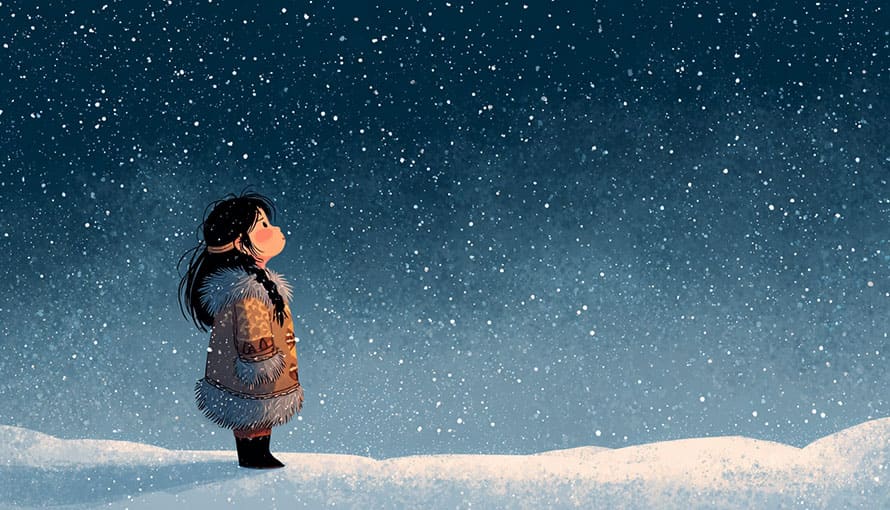
Far beyond the Arctic Circle, where, in winter, the sun almost never rises, there lived a small Inuit tribe. Among them was an old woman named Nuna. Her face was weathered by the icy wind, and her eyes reflected every color of the northern lights. She wasn’t tall, but no one noticed; her wisdom was larger-than-life. Everyone knew her—anyone in the village who needed help went to Nuna for advice. If a little boy got sick, Nuna healed him with herbal tea and kind words. If the hunters weren’t sure where to find seal colonies, Nuna pointed the way.
One evening, as darkness folded over the sky and the oil lamp flickered warmly inside Nuna’s igloo, the children’s curiosity filled her home like gentle light. They huddled around the Inuit elder, snuggled into warm furs, their eyes fixed on her weathered face.
“Grandma Nuna,” piped up the youngest boy, “how do you know everything? How can you always help us?”
Nuna smiled. Her smile was like the glow of a snowy tundra beneath starlight. “All right, my little ones, let me tell you a story—from when I was as young as you are now.”
The children leaned closer so they wouldn’t miss a word. The igloo was wrapped in such quiet that they could hear only the wind brushing snow outside.
“When I was eight years old,” Nuna began, “my mother and father and I were crossing endless, sparkling snowfields. The snow gleamed like silver, and we were halfway back to our village. Suddenly, clouds gathered, and a thick fog closed around us. A snowstorm hit so hard we could barely see our own hands!”
The children shivered, feeling the icy breath of that blizzard. But Nuna went on:
“In that storm, I got separated from my parents. Everything was white. My mother and father called my name, and I called for them, but the howling wind drowned our voices. No matter how hard I tried, I couldn’t see or hear them anywhere.”
The eldest girl blurted, “Weren’t you scared?”
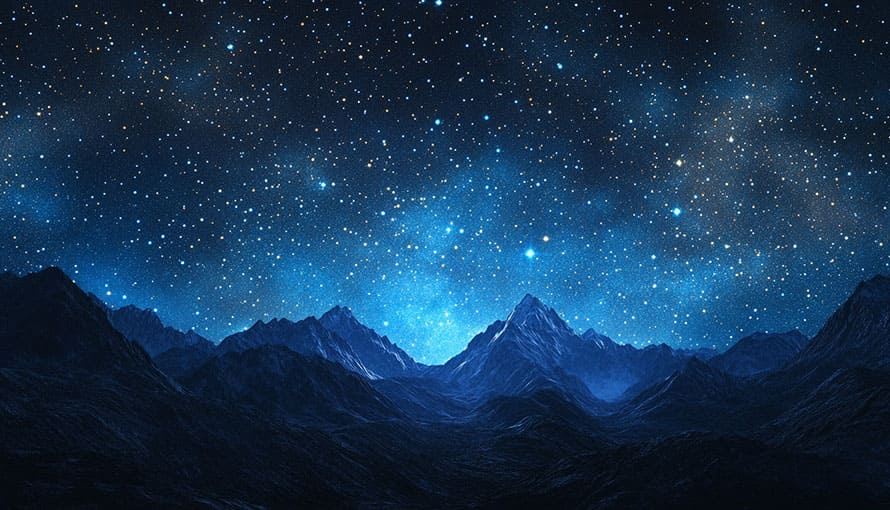
Nuna nodded quietly. “I was terrified—my arms and legs were nearly frozen. I thought I might never see morning. But then the sky cleared a little, and millions of stars appeared overhead. They were so bright, the whole land seemed to glow with silver light.
“All at once, I felt the stars calling to me. When I looked up, it felt like they were smiling down. So I asked them for help. I heard gentle voices. The stars spoke to me—they knew our oldest stories—how, sometimes, they choose one of us to carry their wisdom. This time, they said, they had chosen me.”
One of the kids gasped, barely able to believe what they had heard. “What happened next?” whispered another.
“The stars guided me,” Nuna continued, her eyes far away. “They showed me the way through the blizzard, all the way back to our village. When I arrived home, I found my parents safe too. They were so happy to see me alive and well! And from that day on, whenever someone needed help or advice, I asked the stars to whisper their wisdom to me.”
For a moment, the children were silent. Then the oldest boy spoke thoughtfully: “That’s why you always know what to do. The stars help you.”
Nuna smiled and patted the boy’s head. “Yes, the stars speak to me, but I also have to learn and pay attention to everything around me. That’s why I notice every detail—whether the wind blows from the east or the west, whether the snow is soft or icy, and how high the birds fly. And when you grow up, you can sense the world—and hear what it has to tell you—too. Wherever your own stars lead you, that’s yours to discover.”
Later, the children raced back to their igloos. The moon lit their path, and the polar wind sang them to sleep. Nuna’s eyes kept shining bright, because she knew that, with humility and love, she had lit an endless spark of star-wisdom in the children’s hearts. It was all thanks to the day when, as a little girl, she was lost in a snowstorm and the stars saved her. She never forgot them—and the stars, in return, sparkled for her every night, whispering their wisdom for the whole village to share.
Fun Facts for Kids