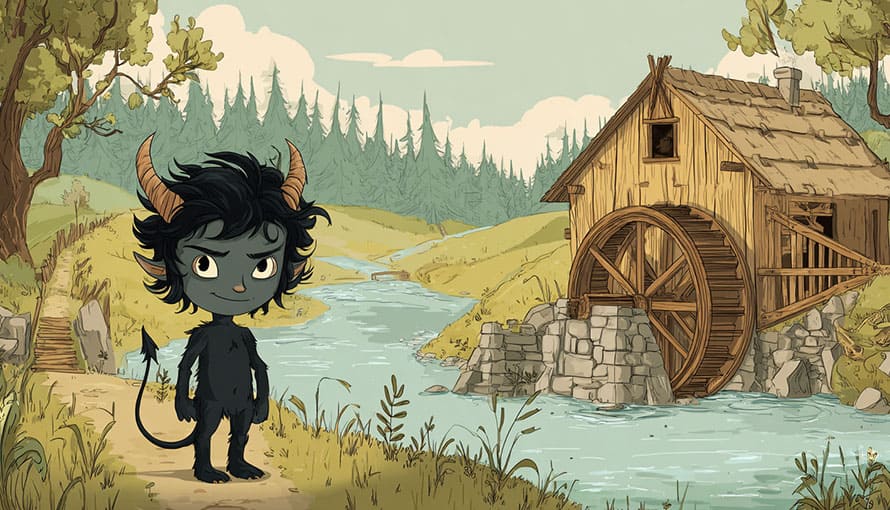
Long ago, in a small village tucked between hills, lived a poor young man named George. He was an orphan, calling a battered shack on the edge of the village home and earning his living doing odd jobs for local farmers. But in his heart he carried a great dream—he wanted to marry Mary, the mayor’s beautiful daughter. Mary’s smile always brightened his day, and George loved her more than anything in the world.
One day, he gathered his courage and went to the mayor to ask for Mary’s hand. The mayor snorted and waved him away.
“So you want my daughter? And what will you give her—a sack of potatoes? You have nothing, not even a proper house! Go, before I laugh you out of here.”
George left with a heavy heart, but a spark still glimmered in his eyes. He decided to go out into the world and find a way to become rich—worthy of Mary.
He wandered for days and nights, through fields scented with wild thyme and forests where sunlight danced between the branches. One evening, he reached a strange village by the river, where a lonely old mill stood. The wheel wasn’t turning, the doors gaped open, and holes in the roof gave glimpses of the sky.
George asked the locals why the mill was left to rot when the river roared outside, ready to spin the wheel. The village blacksmith leaned in and whispered,
“There’s a devil haunting that mill. No one’s set foot there in years. The lord of the land declared that whoever milled flour there again would get to keep the mill.”
George smiled to himself. “I’m not afraid of the devil,” he said, and decided to spend the night in the mill.
Night fell dark and heavy. The moon peeked out now and then from behind thick clouds. George built a small fire in a corner and listened to the water rushing past and the old wood creaking. At midnight came the squeal of hinges, and a cold gust snuffed out the fire.
Out of the darkness loomed a tall figure with a horned head, a black tail, and eyes like glowing embers.
“Who dares sleep in my mill?” boomed the devil, his voice echoing off the walls.
George stood, walked over, and answered calmly,
“I’m George. I’ve come to grind flour. If I bother you, I can leave—but maybe we could help each other.”
The devil paused. “Help? Why would I want to help you?”
George smiled.
“Look, you’ve sat here alone for years, just haunting folks. You must be terribly bored. I need a home and a job. What if we run the mill together? You’ve got strength, and I’ve got hands and ideas. We could both make a living.”
The devil scratched behind his pointed ear and, for the first time in years, laughed.
“You know, you’re the first one who isn’t scared of me. All right—deal. But on one condition: you won’t be afraid, no matter what I look like or what I do.”
George nodded. “And you promise not to hurt me.”
At dawn they got to work. The devil, who called himself Frank, flicked his tail and the mill wheel spun as if the whole river powered it. George fixed the holes in the roof, set out new sacks, and scrubbed the old millstones clean.
Frank was strong—he could carry a full sack of grain as if it weighed nothing. And George was clever—he hung signs all over the village: “The Old Mill Is Working Again!” At first, people came cautiously, but when they saw everyone leaving with fresh, fragrant flour and nothing bad happened to anyone, they started bringing grain by the wagonload.
In the evenings, after the last grain was ground, George and Frank sat by the fire, eating bread, drinking mugs of milk, and trading stories. George learned that Frank wasn’t a bad devil—he’d been kicked out of hell years ago and had been hiding in the mill ever since. Bored, he’d started haunting people for fun.
After a few months, the mill became the busiest for miles around. George earned more than he’d ever dreamed. He had his own house, a horse, and granaries bursting with grain. When he returned to his village, the mayor stared wide-eyed.
“George,” he said cautiously, “I see you’re doing well… If you’re still interested, my Mary is single.”
George grinned, but before saying yes, he invited Mary and the mayor to the mill. When they saw Frank cheerfully tossing sacks of grain and singing devilish tunes, they were speechless. Mary laughed, “I’ve never seen a friend quite like him!”
And so there was a joyful wedding. George married Mary, Frank became their best friend, and the mill hummed day and night; the mill’s great wheel became a symbol of abundance for the whole land.
And the devil? He never scared anyone again. Only sometimes, for fun, he’d hide the grain sacks just to see George puzzle over where they’d gone.
Fun Facts for Kids