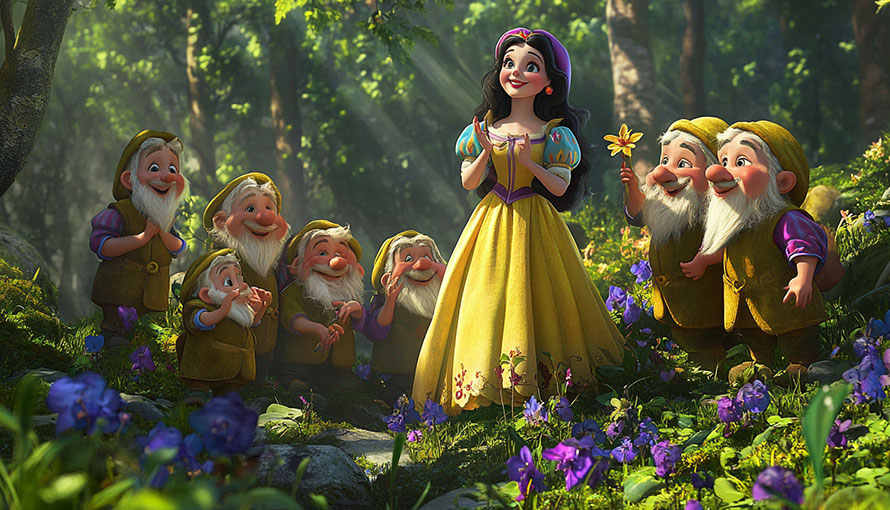
Once upon a time, in a kingdom beyond seven valleys, there lived a princess named Snow White. Her skin was as white as snow, her lips as red as blood, and her hair as black as ebony. Everyone in the castle loved her for her kindness and gentle heart. But her stepmother, the queen, saw in her a threat. The queen was immensely proud of her own beauty and couldn’t bear the thought that someone might be more beautiful than she was.
The Magic Mirror
The queen possessed a magic mirror. Every day, she stood before it and asked:
“Mirror, mirror on the wall, who is the fairest of them all?”
And the mirror always replied:
“Oh, Queen, you are the fairest, not just in our kingdom, but in the whole world.”
That was how things were until one day the mirror said something that pierced the queen’s heart with anger:
“Queen, you are beautiful, but Snow White surpasses you in beauty.”
The queen was consumed by rage and envy. She couldn’t allow anyone to outshine her charm and grace. She decided to harm Snow White, so the girl could never surpass her in beauty again.
Escape to the Forest
The queen summoned the royal huntsman and ordered him to take Snow White deep into the dark forest and silence her forever. As proof that the girl would never return, he was to bring back her heart. The huntsman feared the queen, but he liked Snow White and couldn’t harm her. So he led her into the woods, but couldn’t bring himself to raise his sword.
“Run, child, and hide from the queen’s wrath,” he whispered to her. “You must never return to the castle. She wants your life.”
Snow White, frightened and heartbroken to learn that her stepmother wished her dead, ran among the trees until tears of fear burned her eyes. She wandered through the thick forest, where the leaves rustled eerily and every cracking branch startled her. By chance, she stumbled upon a little house hidden among the trees.
It was a cozy little house, though it looked rather modest at first glance. Inside, she found seven small beds, seven chairs, and seven little plates on the table. Everything was small and cute, but the place was a bit messy, as if its inhabitants weren’t much for tidiness.
The Little House in the Woods
Exhausted and hungry, Snow White thought she would tidy up the house a bit—maybe its owners would let her stay in return. She swept the dust from the corners, then swept the floor, and washed the dishes on the table. When the work was done, she ate a few of the tiny leftovers she found. Then she lay down on one of the little beds. Wondering what would happen next, she drifted into a deep sleep.
In the evening, seven dwarfs came home—they were diligent workers who mined precious metals and gems in the deep mines during the day. The most curious among them immediately noticed that someone had been in their home.
“Someone tidied up here,” he said, raising an eyebrow. “The floor is sparkling!”
Another saw that their plates had been cleaned and that someone had eaten their dinner. They lit their little lamps, and their surprise grew when they found Snow White sleeping in one of the beds. She looked so delicate and beautiful that they couldn’t wait for her to wake up.
When she did, and saw the seven little people around her, she was at first frightened. But the dwarfs calmed her down, and she told them her story—how the queen wanted her dead, and how she would love to stay in their home, where she could be safe.
The dwarfs thought this over. At last, the oldest one said:
“You may stay with us, girl. We will protect you. In return, you can keep the house in order and make us delicious food. But beware—watch out for your stepmother, so you won’t be tricked by her.”
Back at the castle, the queen once again questioned her mirror:
“Mirror, mirror on the wall, who is the fairest of them all?”
The mirror told her the cruel truth:
“Queen, you are beautiful, but Snow White in the little house in the woods is more beautiful than you.”
The Poisoned Apple
The queen was furious and realized the huntsman had betrayed her. He had brought her the heart of a deer he’d killed in the forest as proof. Enraged, the stepmother decided to get rid of the girl herself. She devised a cunning plan, disguising herself as an old peddler woman so no one would recognize her. She took with her a poisoned apple—so tempting and red that just looking at it made you want to take a bite.
The day the dwarfs went off to work in the mine, Snow White stayed home alone. The disguised queen knocked on the door.
“Little girl, I have a beautiful red apple for you. Won’t you buy one?”
Snow White remembered the dwarfs’ warning, but the apple smelled so sweet, and the old woman looked harmless. When she offered it to her, Snow White’s pure heart couldn’t see the malice in the old woman’s eyes.
The moment she bit into the apple, the poison flowed through her body. The girl collapsed, losing consciousness. The queen laughed wickedly and rushed away, believing that her vengeance was complete and that no one could save Snow White.
When the dwarfs came home, they found Snow White lying motionless on the floor. They all wept desperately and tried to revive her, but nothing helped. Unable to say goodbye, they placed her in a glass coffin so everyone could see her innocent beauty.
The Magic of Love
Days turned into weeks, and weeks turned into months. Snow White lay in her glass coffin, still looking as though she were peacefully asleep. News of the beautiful girl spread far and wide, and one day a prince from a nearby kingdom passed by. When he saw Snow White, he instantly felt that he loved her.
“Allow me to take her to my castle,” he pleaded with the dwarfs. “Let me watch over her and honor her forever.”
At first, the dwarfs hesitated, but then they saw real love in the prince’s eyes. They agreed to help him carry the glass coffin. But as they moved it, a piece of the poisoned apple dislodged from Snow White’s throat, and she suddenly opened her eyes. Life returned to her face, and she slowly sat up.
The dwarfs and the prince rejoiced, their eyes sparkling with happiness. Snow White was alive and free of the poison’s spell. The prince asked her to be his bride. Snow White agreed, for she sensed true affection in his words.
A Happy Ending
At the prince’s castle, a grand wedding was held, with the dwarfs as honored guests. The entire land was invited to celebrate with them. When the queen arrived, she still hoped to be the fairest one of all. But in the mirror, she no longer saw herself, but Snow White, whom the people celebrated for her pure heart and extraordinary beauty.
In the end, goodness triumphed and evil vanished. Snow White lived with the prince and the dwarfs in friendship and love. Her story spread across the world to remind everyone that true beauty comes from deep within the heart, and that jealousy, envy, or malice will always find their just punishment in the end.
Prečítajte si aj vtipnú verziu Snehulienky
What Lessons Does the Story of Snow White Teach Children?
Interesting Facts About the Fairy Tale
- Origin and Authors
The story of Snow White (German “Schneewittchen”) comes from the collection Children’s and Household Tales (Kinder- und Hausmärchen) by the Brothers Grimm. It was first published in 1812. According to some historians, the Grimms were inspired by even older folk tales, but their version underwent significant editing and additions. - Differences in the Original Version
The original Grimm version differs from today’s adaptations and contains several darker elements. For example, in some earlier versions, the stepmother asks the huntsman to bring her Snow White’s heart and liver, as she believes eating them would grant her youth and beauty. - Names of the Dwarfs
In the Grimms’ story, the dwarfs have no individual names—they’re simply a collective group. Only in later stage and film adaptations (notably Disney’s 1937 film) did the dwarfs receive unique names such as Doc, Grumpy, Happy, Sleepy, Bashful, Sneezy, and Dopey. - Magical Numbers
Symbolic numbers like three or seven often recur in the Grimms’ fairy tales. In Snow White, the number seven is present in several ways—not just in the number of dwarfs, but also in the seven hills Snow White crosses before reaching the dwarfs’ cottage. - Disney’s Historic Achievement
The animated film Snow White and the Seven Dwarfs (1937) was the first full-length animated movie to be produced in full color, using cel animation technology. This film launched the great era of Disney fairy tales and became a foundation for future animated movies. - Moral Lessons and Symbolism
Snow White carries a deep lesson about goodness, innocence, and how being good is ultimately rewarded. The evil queen represents vanity and jealousy, which lead to self-destruction. The story also emphasizes the value of help and cooperation—even though the dwarfs and Snow White are very different, they support each other. - Timelessness of the Fairy Tale
Even though the story originated more than 200 years ago, it still resonates with readers and viewers across generations. Its conflict—good vs. evil—and its strong visual symbols (black hair, white skin, red lips) remain appealing in modern film and literary adaptations. - Other Film and Stage Adaptations
Countless stage productions, musicals, and television movies have been inspired by Snow White. Besides the Disney classic, there are also live-action films like Mirror Mirror (2012) and Snow White and the Huntsman (2012), which bring darker or different shades to the story. - Inspired by Real People?
According to some theories, the character of Snow White may have been inspired by a historical figure, such as Bavarian Countess Margarete von Waldeck or Maria Sophia von Erthal. Such ideas, however, are unconfirmed and remain speculative. - Why Does Snow White Still Fascinate?
The combination of magical and dark elements (the poisoned apple, the evil queen, the magic mirror), miracles (Snow White’s revival), and simple but powerful moral messages keeps Snow White popular and endlessly adapted into new versions. This story reminds us that innocence and goodness can overcome jealousy and evil, making it, for many, a symbol of hope and kindness.