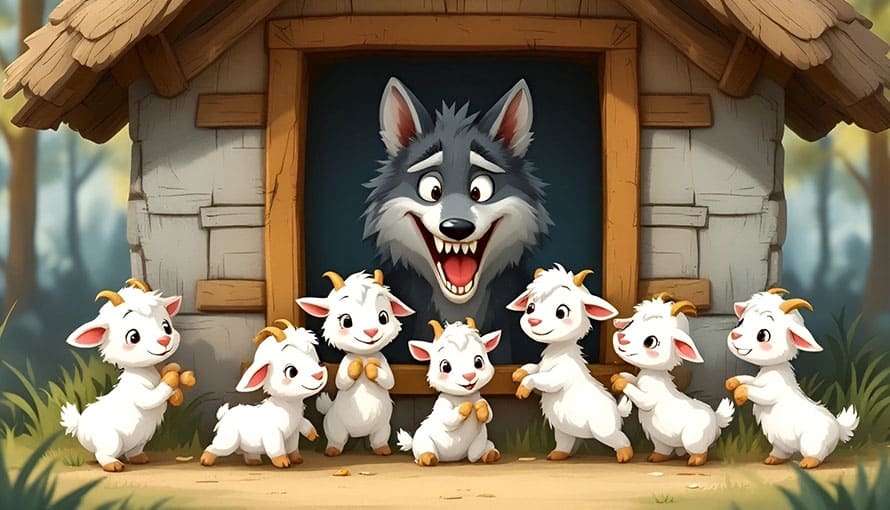
Once upon a time, at the edge of a peaceful mountain, surrounded by emerald meadows and deep green woods, there lived a mama goat with her seven playful little kids. Their cozy cottage, tucked under a big old walnut tree, was always filled with laughter and cheerful voices. The kids loved to play and skip, but their mother had taught them one very important rule: always be careful, because the wicked old wolf prowled through the forest.
One sunny morning, Mama Goat was getting ready to go to the market for flour, bread, and a few little things they needed. Before she left, she gathered her kids close and, with a gentle yet serious voice, warned them:
“My sweethearts, promise me you’ll be very careful! Don’t open the door for anyone until I come back. And whatever you do, never let that sneaky wolf inside. You’ll know it’s him by his rough voice and big black paws. But you’ll always know me—I have a soft, kind voice and snowy white hooves.”
The little kids nodded solemnly. Mama Goat checked the locks one more time and set off down the path. As the kids watched her go, they felt a little nervous, but also proud—they were big enough to watch the house all by themselves.
But Mama hadn’t been gone long before there was a loud knock at the door. The kids’ ears perked up. Outside, a gruff voice called:
“Open up, little ones! It’s me, your mama. I brought you a basket of treats!”
But the eldest kid listened carefully and called out,
“No, you’re not our mama! Her voice is gentle and loving, not harsh and scratchy like yours. You’re the wolf!”
The wolf growled angrily, realizing he’d been caught, and stomped away into the woods.
But wolves are clever. He hurried to the blacksmith in the nearby village and demanded, “Make my voice high and sweet!” The blacksmith was confused, but the wolf begged and whined, so at last, the blacksmith tapped his throat a few times with his hammer (ouch!), and sure enough, the wolf’s voice turned softer.
Feeling proud, the wolf returned to the cottage and knocked gently this time. In the sweetest voice he could manage, he called,
“Little darlings, open up! It’s mama! I’ve brought you honey and fresh bread.”
The kids glanced at each other, unsure—the voice sounded much kinder! But they remembered their mother’s warning.
“Show us your hoof first, so we know you’re really our mama!” they called.
The wolf quickly stuck his paw under the door, but it was still black and dirty. The kids shrieked and refused to open up.
“You’re not our mama! She has white hooves, and yours is big and muddy!”
The wolf slammed his paw against the door, but it wouldn’t budge. Furious, he stormed off into the woods yet again.
But the wolf wasn’t ready to give up. He ran to the local baker and barked,
“Sprinkle my paw with flour! I want it as white as snow!”
The baker, frightened, did just as he was told. Now, with a paw as pale as dough, the wolf headed back to the cottage.
This time, he knocked softly and spoke in the sweetest, warmest voice,
“Little ones, it’s mama! I’ve brought you sweet honey from the market and new ribbons for your horns!”
The kids, still a little unsure, asked once more,
“Show us your hoof, so we know you’re our mama!”
Under the door came a paw as white as fresh bread dough. The kids looked at each other—the hoof was white, and the voice was gentle. They were hungry, and it sounded just like their mother’s promise of treats and ribbons.
The youngest kid hesitated, but the older ones insisted it was safe. Finally, they unlocked the door.
And in burst the wolf with a gust of wind! The kids froze—this was a terrible mistake! With a howl, the wolf lunged, and the frightened kids ran for their lives.
One hid under the table,
One crawled under the bed,
One squeezed into the oven,
Another into the kitchen cupboard,
Another slipped under a bench,
One behind the curtains,
And the tiniest, cleverest one crept into the old grandfather clock and held his breath.
The wolf sniffed them all out one by one…and swallowed each of them whole! He was too quick and strong for the poor little kids. Only the youngest, hidden in the clock, escaped his sharp nose.
Before long, Mama Goat hurried back. She saw the door wide open, the house a mess, her heart pounding with fear as she called her children’s names. No one answered. She called again and again—until she heard a tiny squeak. The youngest, trembling and tearful, crawled from the clock and threw himself into his mother’s arms. Between sobs, he told her the whole story.
Mama Goat was heartbroken—but she knew what she had to do. Together with her bravest little kid, she tiptoed out to look for the wolf. They found him not far away, snoring under a tree, his belly round as a beach ball.
Mama Goat noticed something strange: the wolf’s stomach was wiggling! The lost kids were somehow still alive inside. Quickly, Mama Goat fetched her biggest scissors, needle and thread, and the youngest kid came along to help. The wolf slept so deeply, he didn’t notice as she snipped open his belly—and out came the six little kids, safe and sound!
They hugged their mama tight, grateful and overjoyed to be free.
Mama Goat whispered,
“Let’s teach him a lesson.”
And together, the kids filled the wolf’s stomach with heavy stones. Mama Goat sewed him up good as new.
When the wolf finally woke, he felt terribly thirsty after his “big meal.” He stumbled to the nearby well for a drink, but as he leaned over, the heavy stones pulled him right down into the water—and that was the end of the big bad wolf.
From that day on, the mama goat and her seven kids lived safely and happily in their little cottage under the walnut tree. They tidied their home, hugged each other close, and always remembered their mother’s wise advice: be careful, listen well, and stick together—because love and courage always win in the end.
Zaujímavé informácie pre deti
What Lessons Does “The Wolf and the Seven Little Goats” Teach Children?
Interesting Facts About the Tale
- Origins and Authors
The story of “The Wolf and the Seven Little Goats” comes from the famous collection of German folktales by the Brothers Grimm. It was first published in 1812 in their book Children’s and Household Tales (Kinder- und Hausmärchen). Even before that, the tale had been passed down by word of mouth for generations. The Grimms chose it for its powerful message about learning and growing up. - Plot and Moral
At its heart, this story is a warning about the dangers that can come from trusting strangers—and a reminder of the importance of caution, obedience, and trusting your family. The little goats receive careful instructions so the wolf can’t trick them, but they’re fooled anyway. In the end, their mother’s courage and love save them, and the wicked wolf is taught a lesson he won’t forget. - The Wolf’s Symbolism
In European fairy tales, myths, and legends, wolves often stand for slyness or danger. In this story, the wolf pretends to be someone he’s not (by changing his voice and paw) to sneak up on the young goats. This “wolf in disguise” theme shows up in other tales too, like “Little Red Riding Hood.” - Many Cultural Versions
“The Wolf and the Seven Little Goats” is a favorite fairy tale all over Europe, and there are countless local and regional versions. Most keep the same plot about a mother’s protection and the classic lesson: beware of blind trust. - Influence and Adaptations
The story has inspired children’s books, radio plays, stage performances, and animated films. For younger children, some retellings soften the scary parts, so the story stays enchanting but not too frightening. - Parallels with Other Grimm Tales
Like many stories by the Brothers Grimm (such as “Little Red Riding Hood” or “Hansel and Gretel”), this tale blends the threat that innocent characters face with the happy triumph of good—thanks to family love, teamwork, and clever thinking.
This story remains beloved—not only for its suspense and meaningful lessons, but also for its theme of the smallest and weakest finding a way to overcome evil through the strength of their family.