One sunny morning, a class of first graders set off with their teacher on a long‑awaited field trip to the nearby forest. The children could hardly wait to see the magical nature, the colorful flowers, and the animals that lived among the trees. Each of them packed a small backpack with a snack, some water, and a raincoat—just in case a surprise shower showed up.
As they walked along a soft, leafy forest path, they admired the tall green trees whose thick branches made a cool, shady roof over their heads. Birds sang cheerful songs, and a gentle breeze rustled the leaves. The children scattered in every direction, eager to discover all the forest’s secrets. Some stayed close to their teacher, while others pretended to be explorers, searching for interesting leaves and wild berries.
After a while, they came to a tiny stream that bubbled happily along. Its crystal‑clear water tempted the children to cool their hands in it. The banks were covered in smooth stones where the kids sat and watched little fish darting between underwater plants. A few children took off their shoes and giggled as they splashed their bare feet in the cold water, feeling the tickle of the stream between their toes.
When they’d had their fill of splashing and exploring, they moved on to a wide, sunny meadow. It was covered with colorful flowers and full of butterflies dancing in the air. The children ran after them, trying to catch at least one of those delicate dancers. But the butterflies turned their chasing into a game—always dodging their reaching hands and fluttering just out of reach.
Then the teacher decided it was the perfect time for a break and lunch. Each child opened their backpack and took out the treats their parents had packed. Some had tasty sandwiches; others had fruit or homemade cookies. They happily began to eat.
But there were a few children who didn’t think about their trash once their bags were empty. They pulled out plastic wrappers, banana peels, and candy bar packages and tossed them onto the soft forest floor.
“It’s just a little trash,” muttered Paul as he flung his banana peel near the edge of the stream.
“It’ll just disappear out here,” added his friend Gabby as she threw her cookie wrapper onto the grass.
Some of the others watched—some frowning, some shrugging and copying them. Soon more wrappers and bits of trash lay scattered around.
When everyone had finished eating, they headed back toward the stream to play and rinse their hands again. Suddenly there was a strange rustling in the bushes. The children turned, but saw no one.
Then came a big surprise.
When they later looked inside their backpacks, they found all the trash they had thrown away just moments before. Everyone started accusing each other.
“You put this in my bag!” Matt shouted at Katie.
“Me? No way, it was definitely John!” Katie protested, pointing at another boy.
They all stared at each other, confused. Who could have put all that trash back? Some of them felt a little spooked; others thought it might just be a prank. But when they tried dropping their trash on the forest floor again, they soon found it back in their bags once more. Now they were really puzzled—and more than a little nervous.
All at once, tiny figures stepped out from the underbrush.
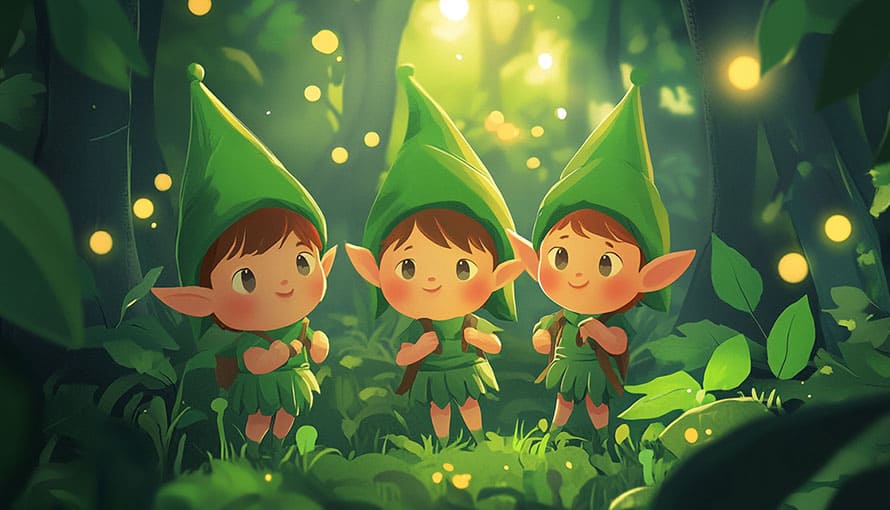
They were small forest elves. On their heads they wore green caps that looked like leaves, and in their hands they carried little baskets for collecting trash. The girls squealed in surprise, and the boys’ eyes grew wide—no one had expected to meet real elves in the forest!
“Who are you?” one of the boys asked quietly.
“We are the forest elves,” answered the oldest one. “We guard our forest and keep it clean. When we saw you throwing trash around, we knew we had to do something. Nature is home not only to us but to many animals, plants, and, of course, to you humans as well. That’s why we must protect it.”
“But it’s just one banana peel… what harm can that do?” Paul objected.
“It may not look like much,” the elf went on, “but when lots of people act that way, the forest suddenly fills up with litter. And some kinds of trash take a very, very long time to break down.”
“Like what?” Gabby asked, curiosity winning over her embarrassment.
“Well,” said another elf, who wore tiny glasses on his nose, “a banana peel can take about two to five weeks to decompose. Paper might take a few months. But glass? Glass can take thousands of years to break down! And plastic—plastic can last hundreds of years, or even longer…”
The children’s mouths dropped open.
“Thousands of years?” Katie gasped. “So if we leave a glass bottle here, it could still be here when our great‑great‑great‑grandchildren are alive?”
“That’s exactly right,” said the elf with a serious look. “And now imagine that some forest animal mistakes a wrapper for food and gets hurt—or eats it. Plastic can make it very sick. Glass can cut its paws or mouth. It’s really dangerous.”
The children looked at each other, feeling ashamed. Even Paul and Gabby—who had first thought that throwing trash in the woods was no big deal—now realized what a huge mistake they’d made.
“We really didn’t mean to do anything bad,” they said quietly. “We had no idea it took so long to break down—or that it could hurt animals.”
“We’re not here to scold you,” said the smallest elf in a gentle voice. “We just want you to understand that even a little piece of trash can cause a lot of harm. Every one of us should care for nature so it stays beautiful and clean for anyone who comes to visit. Nature is our shared treasure.”
For a moment, the children didn’t say a word. Then they all looked down at their backpacks, where all their trash had reappeared. This time, no one complained. They kept the trash in their bags willingly and started picking up the rest of the litter that had been left around the meadow. They carefully put everything into their pockets and backpacks so they could throw it away in a trash can back at school or at home.
“Thank you for opening our eyes,” Katie said. “We’ll never throw trash in nature again.”
The other children nodded and added their own promises. The elves smiled and waved goodbye. Then they slipped quietly back into the deep forest, disappearing among the branches and tall grass so silently that it was almost as if they had never been there at all.
The children exchanged excited looks. They agreed that from now on they would always take care of nature they loved so much. They understood how important and precious the forest really was, and that together—step by step—they could do a lot to keep it healthy and beautiful.
And so they all returned to their teacher with smiles on their faces and set off on the path back home, their hearts full of peace and a new determination to keep the promise they had made to the tiny forest elves.
Fun Facts for Kids